
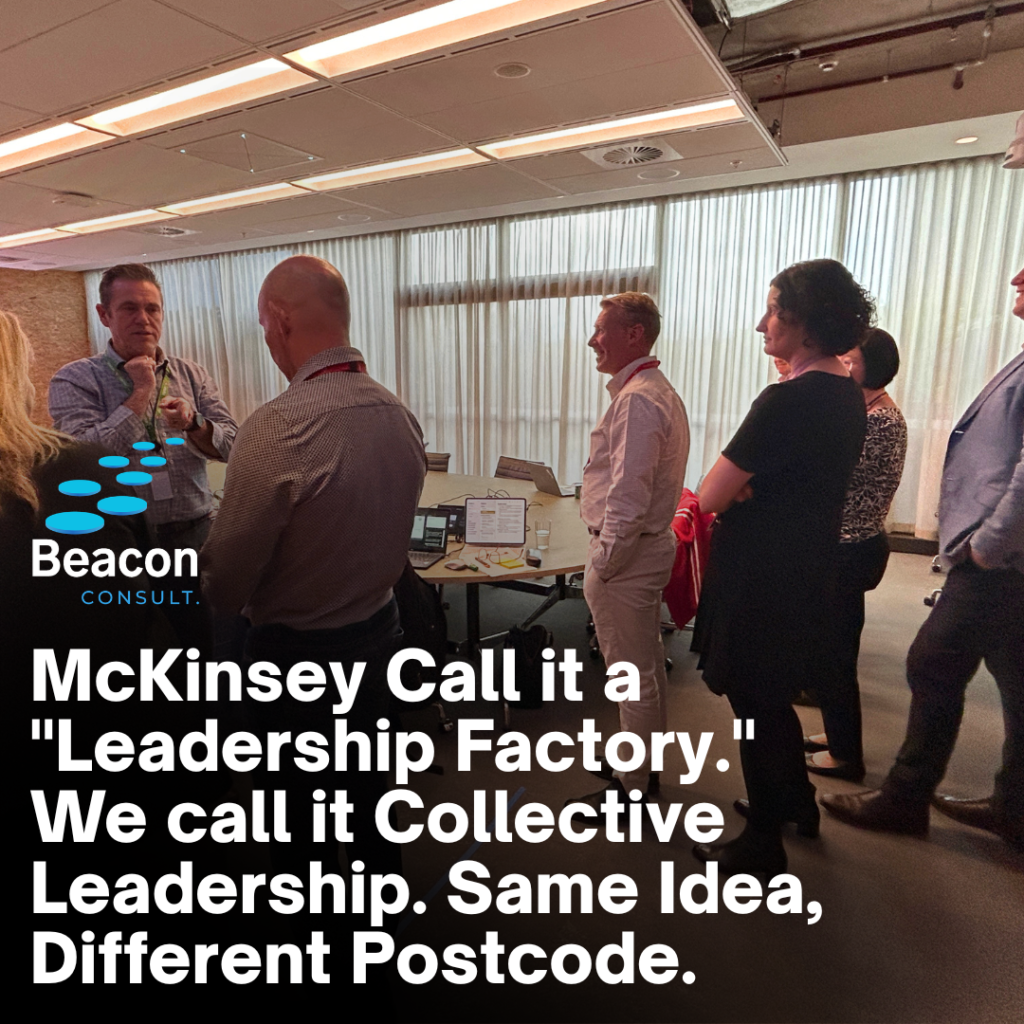
McKinsey call it a "leadership factory." We'd call it Collective Leadership. Same idea, different postcode.
Why Some Organisations Keep Producing Great Leaders (And Others Keep Hiring Them)
McKinsey’s global managing partner and two of its senior partners published a piece recently making a claim that should unsettle most leadership teams: ten years ago, CEOs and their top teams were typically juggling four or five critical issues at any one time. Today, that number has roughly doubled.
Their conclusion isn’t a new strategy framework or a technology fix. It’s that the organisations coping best have simply built deeper leadership benches, and they’ve built them deliberately, as a structure, not hoped for them to emerge.
They call it a “leadership factory.” We’d call it Collective Leadership. Same idea, different postcode.
Leadership isn't a trait you look for. It's infrastructure you build.
Most leadership teams still treat leadership development as something HR runs in the background; a course here, a 360 review there, maybe a high-potential program if budget allows. McKinsey’s argument, backed by decades of their own internal practice, is that this gets it backwards. The most effective leadership development happens on the job: stretch assignments handed to people before they feel ready, senior leaders personally mentoring two or three levels down, and feedback loops that are relentless rather than annual.
This is precisely the distinction we push clients to make. Collective Leadership isn’t “be a better leader” repeated at everyone in the org chart. It’s a deliberate design question: where does leadership capability actually need to exist, board, executive, and management layer, and what’s the system that builds it there on purpose, rather than by accident or attrition?
Get that design wrong and you end up with what McKinsey elsewhere calls “the trustworthy few,” the same handful of proven people absorbing every hard problem while the rest of the bench stays undeveloped. Get it right, and the organisation can absorb the next disruption without the CEO personally holding the whole thing together.

The traits matter less than the system around them
McKinsey lists six personal attributes worth having; energy, humility, resilience, a service mindset, a sense of humour, and a “steward, not owner” mentality. All fair. But buried in the practices section is the more useful idea: a culture of trust isn’t a value statement, it’s an equation. Credibility, reliability, and intimacy, divided by self-orientation. Take any one of those down and the whole thing collapses, no matter how impressive the leader’s personal traits are on paper.
That’s a Trust Climate observation dressed up in McKinsey language. You can put six brilliant, energetic, humble people in a room and still get a team that doesn’t trust each other, because trust isn’t a personality trait, it’s a pattern of behaviour over time, and it has to be actively managed like any other capability.
The same goes for their point on “enrolment” versus buy-in. Buy-in is compliance with better manners. Enrolment is when people carry the mission because they’re personally invested in it, not because they nodded along in a town hall. That’s a Shared Direction problem, and it’s one we see constantly: leadership teams that have agreement in the room and nothing resembling enrolment once people leave it.

The uncomfortable part for CEOs
McKinsey’s closing point is the one most leadership teams quietly avoid: the CEO has to become, in effect, the chief talent officer. Not delegate it. Personally know who the high-potential people are three levels down. Personally protect the ones who don’t fit the mould, because those are often exactly the people who’ll lead the organisation into whatever comes next.
That’s a bigger ask than most CEOs are set up for, and it’s precisely why leadership capability can’t be left as a talent-team initiative bolted onto the side of the business. It has to be designed in, at board level, at executive level, and in the layer of management that’s actually running the place day to day.
McKinsey has essentially independently rediscovered Collective Leadership, called it a factory, and put a very large research budget behind proving it works. We’ll take the endorsement.
Beacon Consult helps CEOs and senior leadership teams build the leadership infrastructure, not just the leadership traits, that organisations need to withstand what’s coming next. If your leadership bench relies on the same three or four people, we’d love to start a conversation.
