
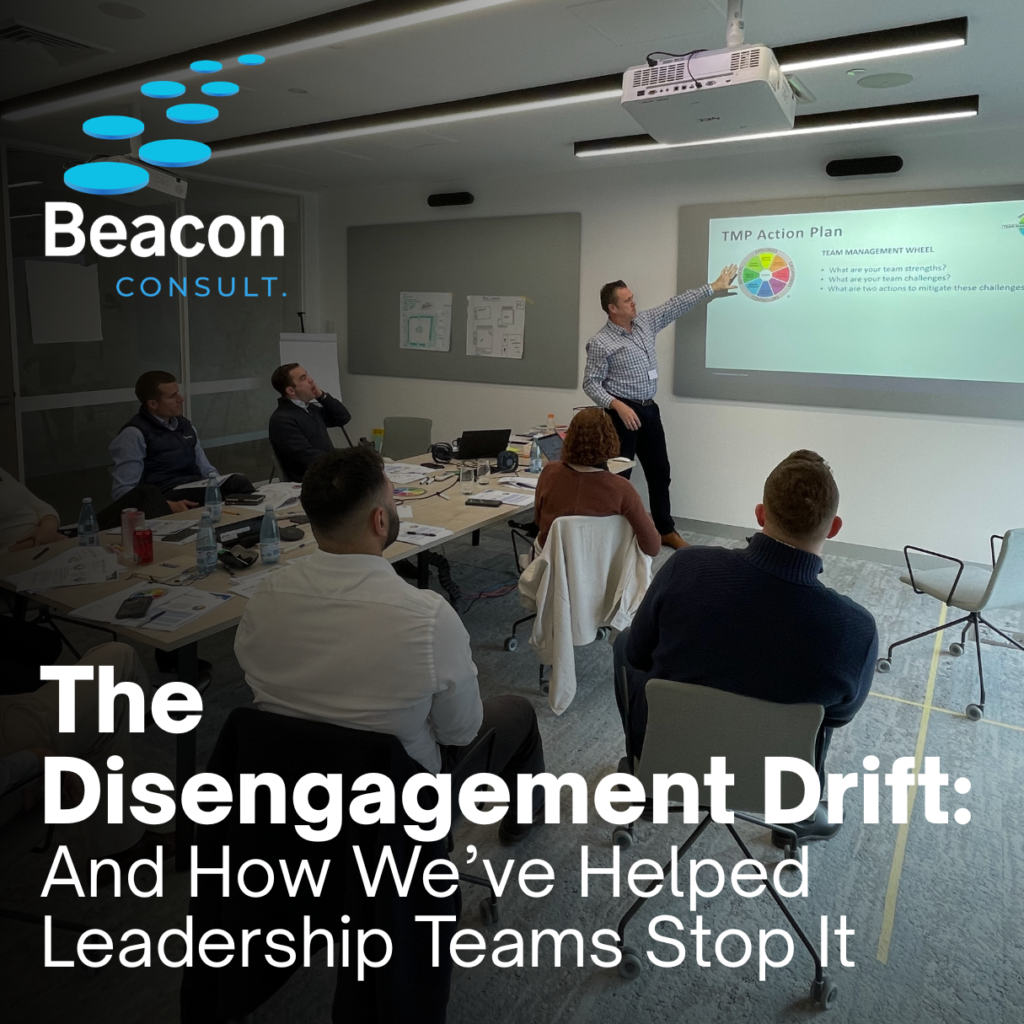
The Disengagement Drift - And How We’ve Helped Leadership Teams Stop It
The ‘Quiet Quitting’ Phenomenon, And What Leadership Teams Can Do About It
Gallup’s State of the Global Workplace report put numbers to something many leaders have been feeling for a while: engagement has slipped, and it’s slipping in ways that are hard to ignore. Only 23% of employees are thriving or engaged, 59% are “quiet quitting”, and 18% are actively disengaged. In Australia and New Zealand, the picture sharpens even further with 43% of employees are actively looking for a new job right now. Not browsing. Not curious. Looking. It’s tempting to treat these numbers as a macro trend; something happening “out there” in the labour market. But the real cost is that most leadership teams don’t have a shared, practical language for talking about why this is happening inside their own organisation. They feel the symptoms like slow decisions, rising tension, people quietly withdrawing, but they don’t have a way to name the underlying dynamics without someone getting defensive – which is the real problem worth naming.
The Missing Ingredient: Emotional Intelligence, Not Another Strategy Deck
There’s a reason this gap keeps biting. Emotional intelligence (not IQ, not technical skill) accounts for 58% of a leader’s job performance (Bradberry). Yet most leadership development still starts with strategy decks, operating models, and frameworks that look great on slides but don’t change what happens when the team sits down to work through something. In our experience:
- Self‑awareness is the thing that shifts behaviour.
- Behaviour is the thing that shifts culture.
- Culture is the thing that shifts engagement.
But most leadership teams never get to that first step. They’re too busy, too stretched, or too used to talking about performance in abstract terms. So the real conversations (the ones about trust, conflict avoidance, decision habits, and interpersonal blind spots) never happen. Or worse yet, they happen in the carpark afterwards.

Why This Hurts Most at the 50–500 Person Stage
The engagement problem isn’t evenly distributed. It hits hardest in organisations between 50 and 500 people, the stage where complexity is there, but infrastructure isn’t. At this size:
- There’s no HR business partner embedded in every team.
- There’s no dedicated L&D function running leadership programs.
- There’s no slack in the system for a 12‑month culture initiative.
- And there’s definitely no appetite for consulting theatre.
Leadership teams here are small enough that one person’s behaviour becomes the culture. A single disengaged executive, a single conflict‑avoidant leader, a single person who dominates the room – that’s all it takes to shift the entire team’s operating rhythm. These organisations don’t need theory, they need something practical, fast to deploy, and immediately useful in the next leadership meeting. Something that gives the team a shared language without requiring a year-long program to understand it.
What Team Management Profile Does (Without the Theory)
This is where the Team Management Profile (TMP) earns its keep.
It’s not a personality test. It’s a map of how work gets done in a team and where the gaps are.
The Types of Work Wheel breaks team effectiveness into the work every high‑performing team need covered: advising, innovating, promoting, developing, organising, producing, inspecting, maintaining. Every team needs all eight. Most teams unconsciously cluster around two or three, and there lies the risk.
- Some teams are brilliant at generating ideas but terrible at finishing them.
- Some are exceptional at execution but allergic to questioning the plan.
- Some are strong on relationships but weak on challenge.
- Some are structured but stagnant.
The wheel makes these invisible gaps visible, in one session.
It shows:
- where the team is naturally strong
- where it’s exposed
- who enjoys what types of work
- and where the blind spots are likely to appear in decisions, meetings, and delivery
It’s backed by a global database of 657,000+ profiles, and independently reviewed and endorsed by the British Psychological Society for its practical validity with real managers, not just researchers.
But the real value isn’t the report, it’s the conversation it unlocks.

How Team Management Profile Plugs into Leading Lights
TMP is diagnostic input, not the destination. It feeds directly into two of the Five Leading Lights:
- Trust Climate: how the team works together, where tension sits, and why certain conversations feel more difficult than they need to.
- Decision Velocity: who’s actually driving decisions, who’s missing from the table, and why some decisions stall or get reopened
It’s the Understand phase of the Understand → Change → Sustain methodology. It gives a leadership team a shared, non‑defensive language before any change work starts. It’s the difference between “you’re difficult” and “our preferences cluster heavily around producing and organising, and we’re missing challenge and innovation.”
One is personal. The other is useful.
Proof It Works: Three Rooms This Year
This isn’t theory. It’s what’s happened in real rooms this year.
A large national logistics organisation used TMP alongside Leading Lights to help a newly appointed GM realign an Enterprise Sales leadership team, helping them build trust and a shared understanding of what high‑performing actually meant for that group.
Fluenccy’s leadership team spent a full day mapping their work preferences, surfacing exactly where they were clustered and where they weren’t.
Natrio’s leadership team did the same (with Finance still underway). Same pattern: a fast, one‑day investment that gave the team a shared map of itself.
Three very different leadership teams with the same result: a room full of senior people suddenly able to have a direct conversation about why things weren’t working without anyone getting defensive.
There lies the real value. The conversation it makes possible.
Behind every engaged workforce is a leadership team creating the right conditions for people to thrive. Beacon Consult partners with CEOs and executive teams to improve employee engagement, strengthen leadership capability, and build high-performing teams through Team Management Profile and the Leading Lights framework. If you’re ready to move beyond the symptoms and address what’s really driving disengagement, we’d love to talk.
